Compare Travel Insurance Plans: 12 Companies Side by Side
Comparing travel insurance means putting the plans next to each other on the numbers that pay when something goes wrong: emergency medical, evacuation, the cancellation refund, the pre-existing condition waiver window, and the two upgrades you can only add in the first days after your first payment. The price comes last, because a cheap plan that carries $10,000 of medical is not cheap on a trip outside the US. This page shows you what to compare, puts the 12 companies we review side by side, and walks through the CoverTrip comparison step by step with screenshots, so you can price every top plan for your own trip in about two minutes.
The six numbers to compare
Every plan on the comparison lists these six things. Read them in this order and the choice usually makes itself.
| What to compare | What to look for | Our floor for a trip outside the US |
|---|---|---|
| Emergency medical | The limit per person, and whether it pays primary (first) or secondary (after your health plan). Medicare does not pay outside the US. | $100,000, and $250,000 for a cruise, a remote trip or a traveler over 65 |
| Medical evacuation | The limit per person for an air ambulance or medical flight home. | $250,000, and $500,000 for a cruise or a remote trip |
| Trip cancellation | The share of your prepaid trip cost refunded for a covered reason. Most plans pay 100 percent; the list of covered reasons is the fine print that matters. | 100 percent of the insured trip cost |
| Trip interruption | The share refunded if the trip is cut short, usually 100 to 175 percent, because getting home early costs more than the trip. | 150 percent |
| Pre-existing condition waiver | How many days after your first trip payment you have to buy and still get the waiver: 24 hours to 21 days by plan. Miss it and the look-back period applies. | Buy inside the window, insure the full trip cost |
| Cancel for any reason | An optional upgrade that refunds 50 to 80 percent for reasons the plan does not list. It must be added inside the same short window. | Only if you may cancel for a reason the plan does not cover |
Travel insurance has no deadline of its own: you can buy a plan right up to the day you leave. The two upgrades above are the only things with a clock on them.
The 12 companies at a glance
These are the top plans from the 12 companies we review, from the insurers’ own plan documents. Nine of them are priced on the CoverTrip comparison; Allianz, Travel Guard, American Express and TravelSafe sell direct only, and the comparison shows you what beats them for the same money.
| Company | Top plan | Emergency medical | Evacuation | Cancel for any reason | Waiver window | Kids free | On the comparison |
|---|---|---|---|---|---|---|---|
| Seven Corners | Trip Protection Choice | $500,000 (primary) | $1,000,000 | Upgrade, 75% back | 20 days | No | Yes |
| Tin Leg | Gold | $500,000 primary | $500,000 | Upgrade, 75% back | 14 days | No | Yes |
| Travel Insured | Worldwide Trip Protector Platinum | $500,000 | $1,000,000 | Upgrade, 75% back | 14 or 21 days (plan document) | Yes, 17 and under | Yes |
| Generali | Premium | $250,000 | $1,000,000 | Upgrade, 75% back | Within 24 hours of final payment | No | Yes |
| Travelex | Ultimate | $250,000 ($50,000 in New Hampshire) | $1,000,000 | Upgrade, 75% back, up to $7,500 | 21 days | One per adult | Yes |
| Trawick | Pathway Premium | $200,000 primary | $1,000,000 | Upgrade, 75% back | 21 days | No | Yes |
| GoReady | Elite | $250,000 | $500,000 | Upgrade, 75% back | 14 days | No | Yes |
| Berkshire Hathaway | LuxuryCare | $150,000 | $1,000,000 | Upgrade, 50% back, trips up to $10,000 per traveler | 15 days | No | Yes |
| Travel Guard | Deluxe | $150,000 | $1,000,000 | Upgrade, about 50% back | 15 days | One per adult | Direct only |
| Allianz | OneTrip Premier | $75,000 | $1,000,000 | Cancel Anytime upgrade, 80% back | 14 days | Yes | Direct only |
| American Express | Build your own | You choose the amount | You choose the amount | No (Trip Cancel Guard, airfare only, sold separately) | 14 days | No | Direct only |
| TravelSafe | Classic Plus | Shown in the quote tool | Shown in the quote tool | Upgrade, 75% back | Plan document | No | Direct only |
Limits are per person and change by state; the plan document you get with a quote is the one that counts. American Express lets you choose your own limits and TravelSafe publishes its limits inside the quote, so neither fits in one row. The company reviews go plan by plan, and the two-company comparisons put any pair head to head.
How to compare travel insurance on CoverTrip, step by step
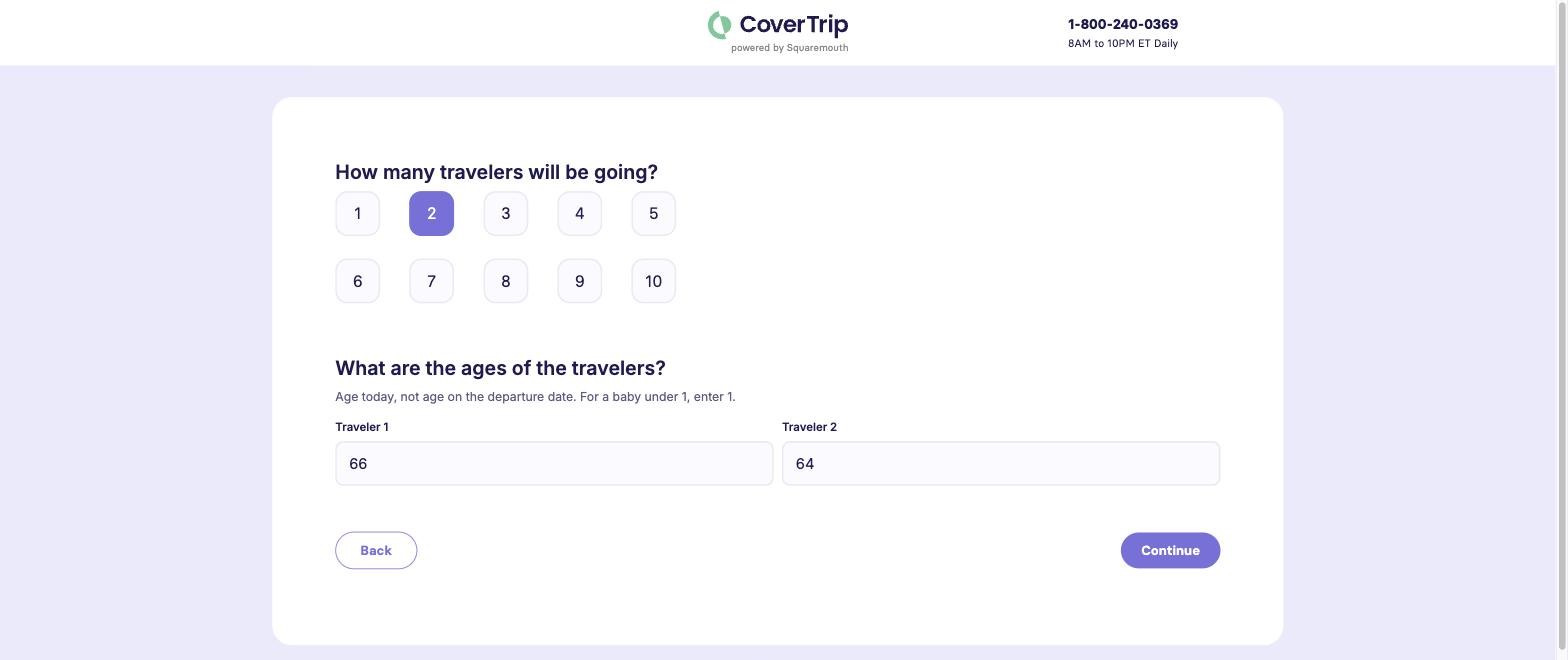
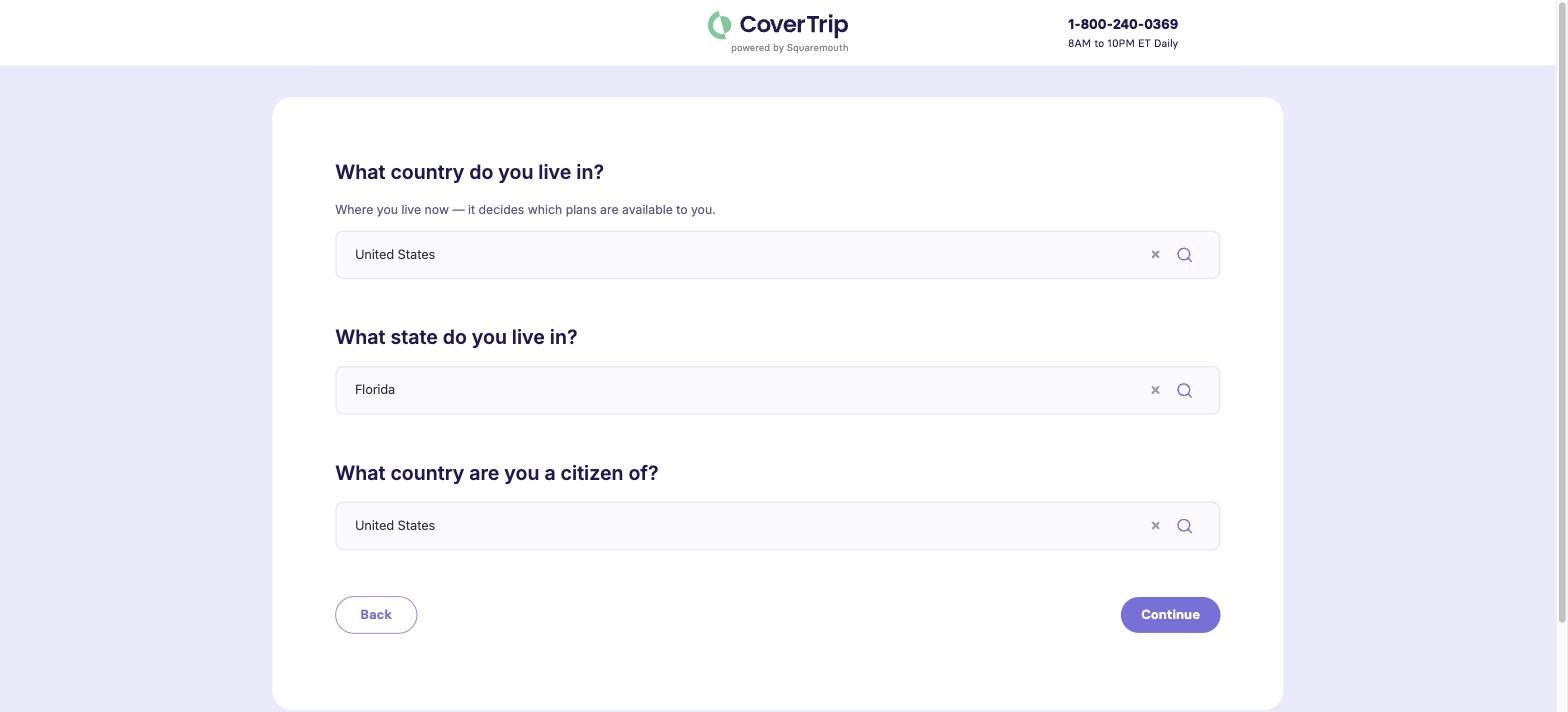
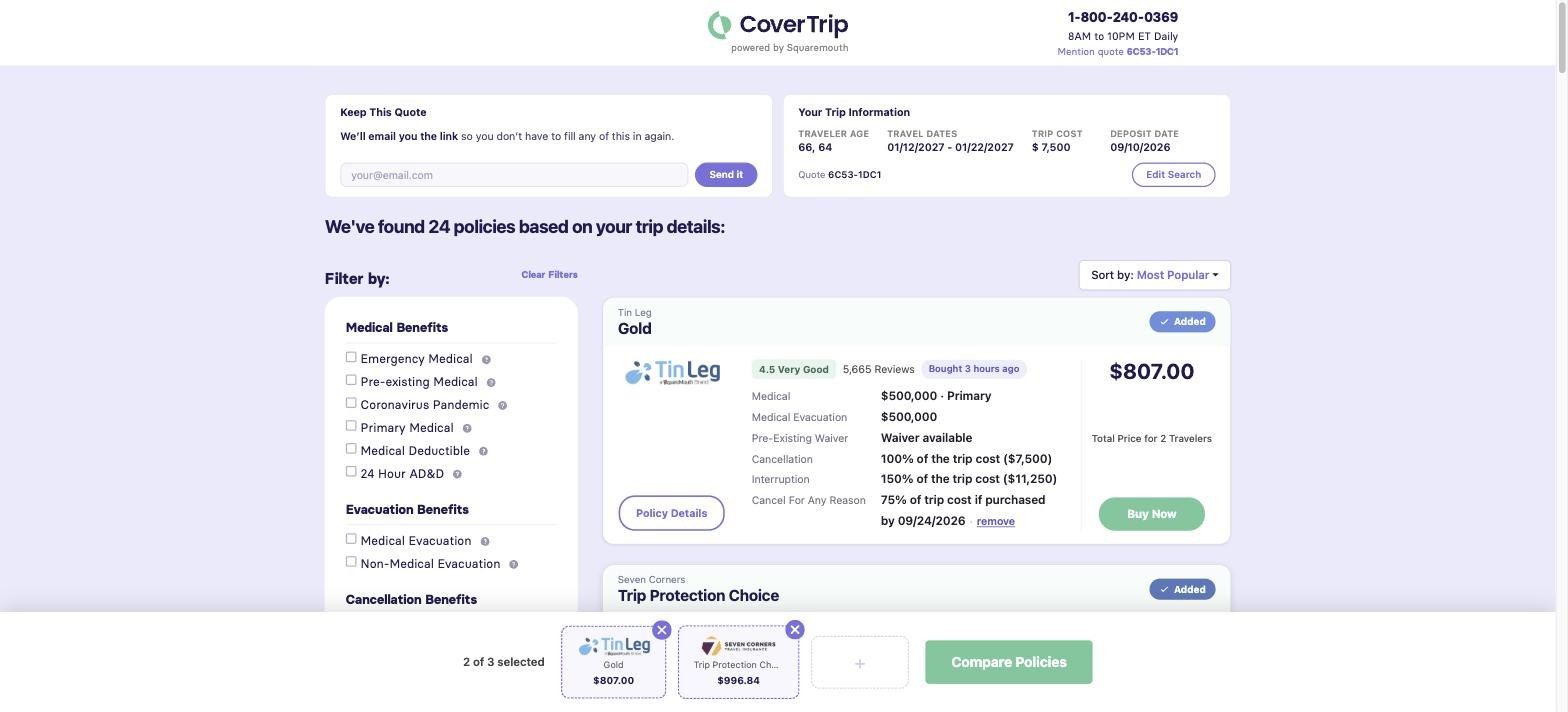
The comparison asks six questions about the trip, then prices every plan that fits. The screenshots below use a sample trip: two travelers aged 66 and 64 from Florida, ten days in Italy in January 2027, $7,500 prepaid, first deposit paid 10 September 2026. Have three things ready before you start: the trip dates, the total you have prepaid, and the date you made the first payment.
Step 1: Where are you going?
Enter the main destination. Going to more than one country? Enter one; the plan covers you in all of them.

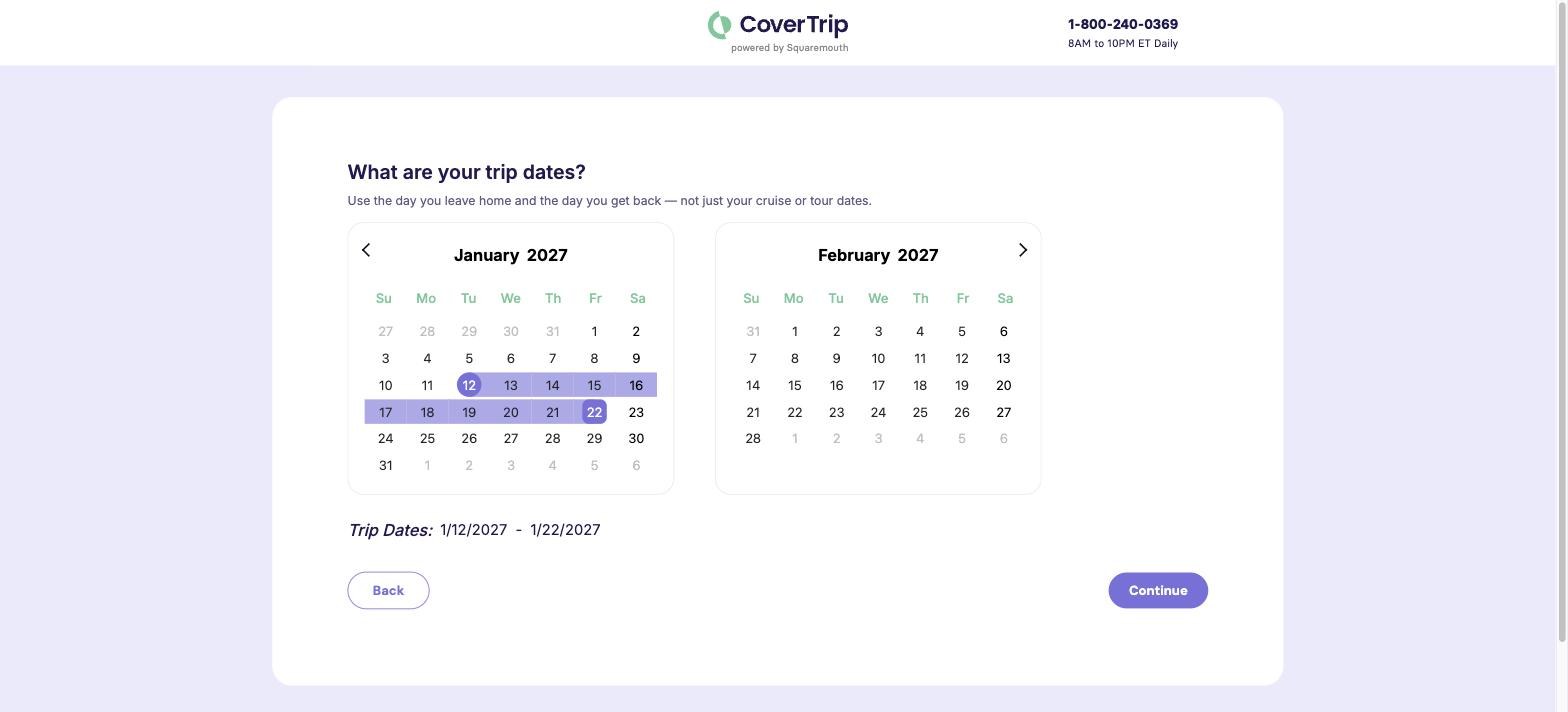
Step 2: When do you leave and get back?
Use the day you leave home and the day you get back, not the cruise or tour dates. The trip length is one of the three things that set the price.
Step 3: Who is going?
Enter each traveler’s age today, not their age on the departure date. Age is the second thing that sets the price, and it is why a plan can cost twice as much for a couple in their 60s as for a couple in their 30s.
Step 4: Where do you live?
Your state decides which plans you can buy and what the plan document says, because travel insurance is regulated state by state. Travelers in the same household can share a policy; travelers in different states cannot.
Step 5: What did you prepay?
Say yes to trip cancellation and enter the total of your prepaid, nonrefundable costs: flights, hotel, cruise, tours. This is the third thing that sets the price. If you are still booking, enter what you have paid so far; you can add the rest to the policy later.

Step 6: When did you make the first payment?
The date of your first deposit, on anything, is the date the waiver and cancel-for-any-reason windows count from. Enter it exactly; the comparison uses it to tell you which upgrades you can still add. Then say whether the trip is paid in full.

How to read the results
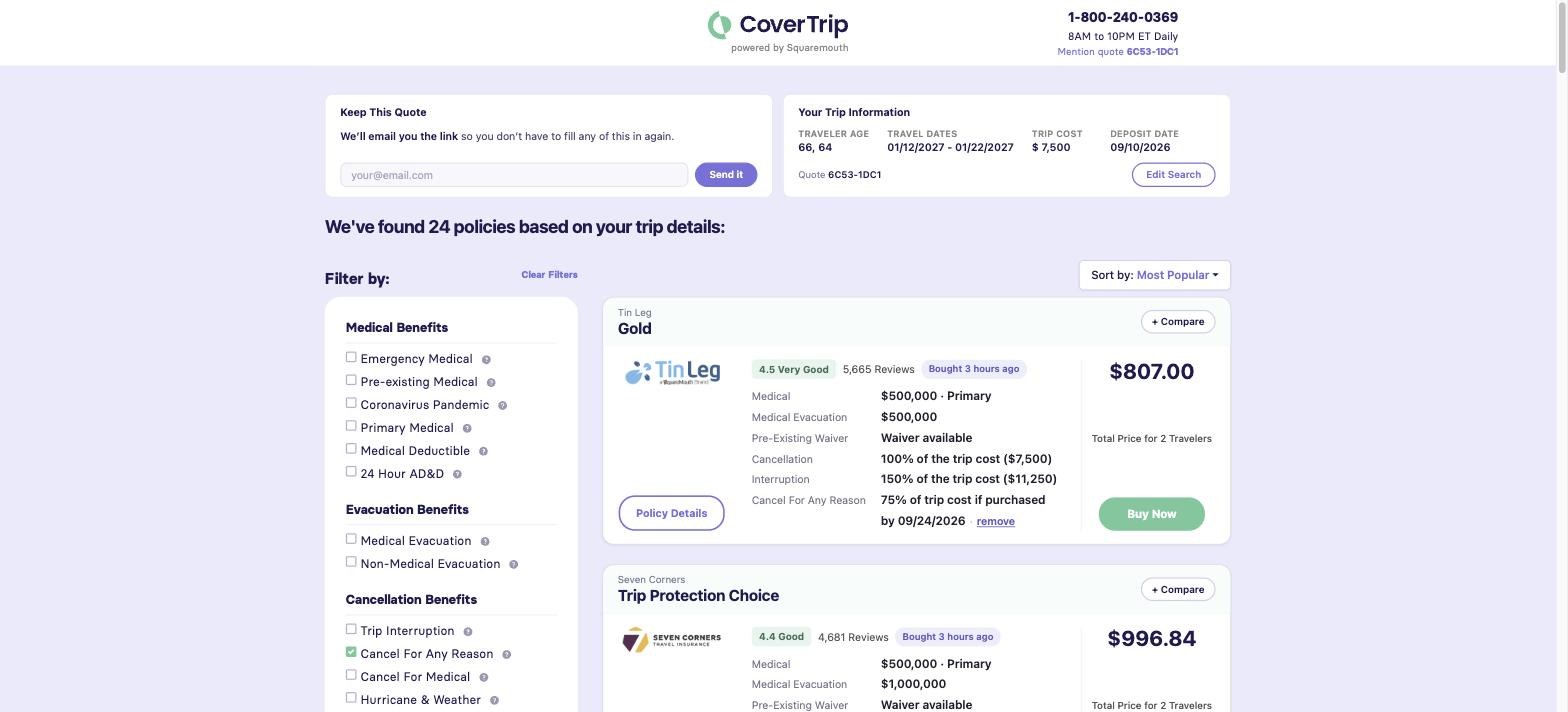
The results page prices every plan that fits the trip: 49 plans for the sample trip, from more than 20 companies. Each card shows the company and plan name, the traveler rating and review count, the medical and evacuation limits, whether the waiver is available, the cancellation and interruption refunds in dollars for your trip, and the total price for everyone traveling. The quote number at the top brings the whole search back later, and the email box sends it to you.

Use the filters to hide plans that do not fit
The filter column on the left hides every plan that does not carry a benefit. Tick Emergency Medical or Medical Evacuation to hide thin plans; tick Cancel For Any Reason to see only plans that still let you add it, priced with it included. In the sample trip that cuts 49 plans to 24 and raises Tin Leg Gold from $538 to $807, which is what a 75 percent cancel-for-any-reason upgrade costs on a $7,500 trip. The filter groups cover medical, evacuation, cancellation, delay and baggage, trip-specific benefits such as cruise, sports and rental car, and provider features.
Open Policy Details before you buy
Policy Details opens the full benefit list for one plan: the traveler rating, the insurer’s AM Best rating, every limit with a plain-English note, and a link to the certificate, which is the actual policy wording for your state. Read the certificate for anything you are counting on.

Compare every top plan priced for your trip
Enter your trip once and every top plan comes back side by side, priced for your dates. Same price as buying direct.
See plans & pricesAbout 60 seconds. Nothing to sign up for.Comparing two plans side by side
When it is down to two or three plans, click Compare on each card and then Compare Policies. The side-by-side view lines up every benefit in rows, marks the best value and the most coverage, and has a switch to hide the rows where the plans match, so only the differences are left.
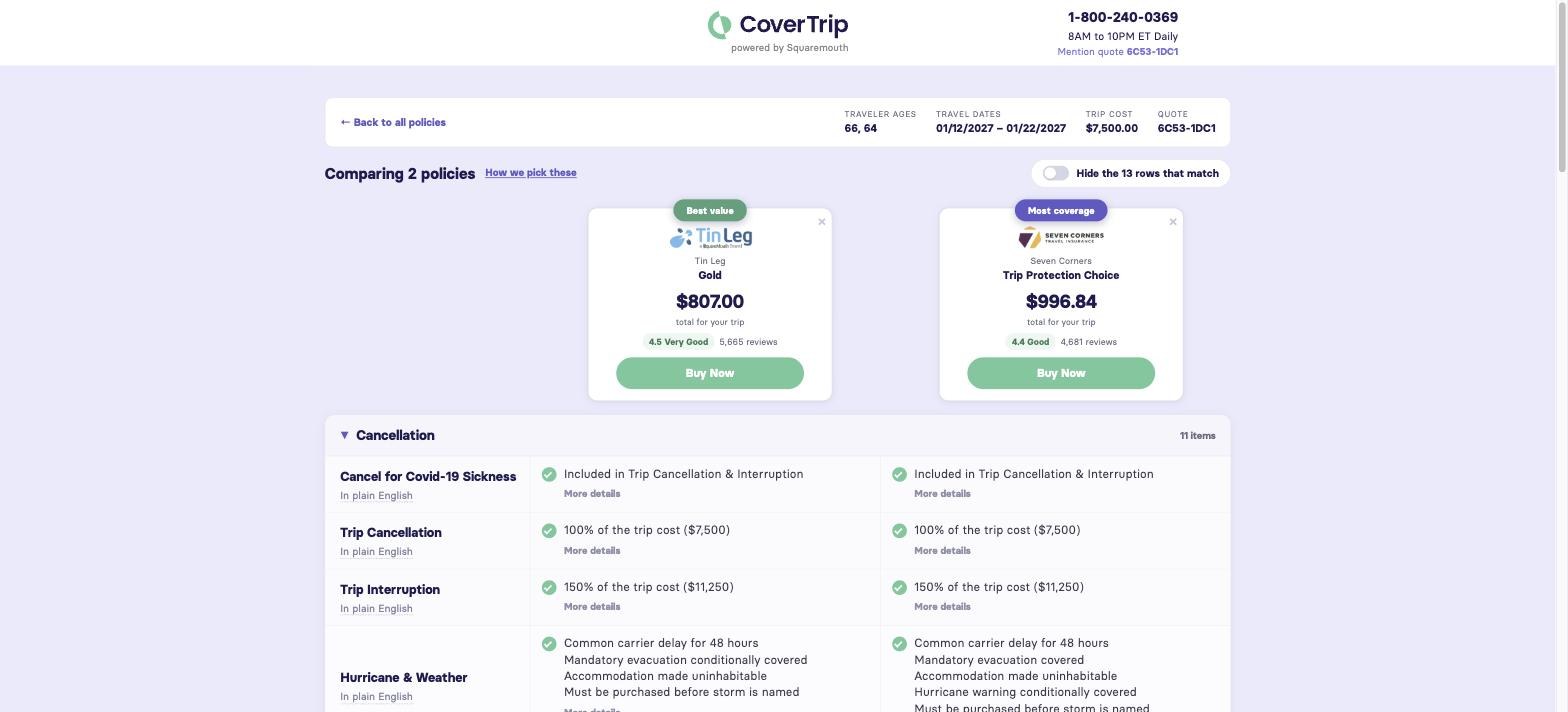
Each row has a plain-English line under the benefit name and a More details link to the wording. In the sample trip both plans refund 100 percent for cancellation and 150 percent for interruption; they differ on hurricane wording, financial default, employment layoff and the cancel-for-any-reason cap, which is exactly what you want the view to surface.
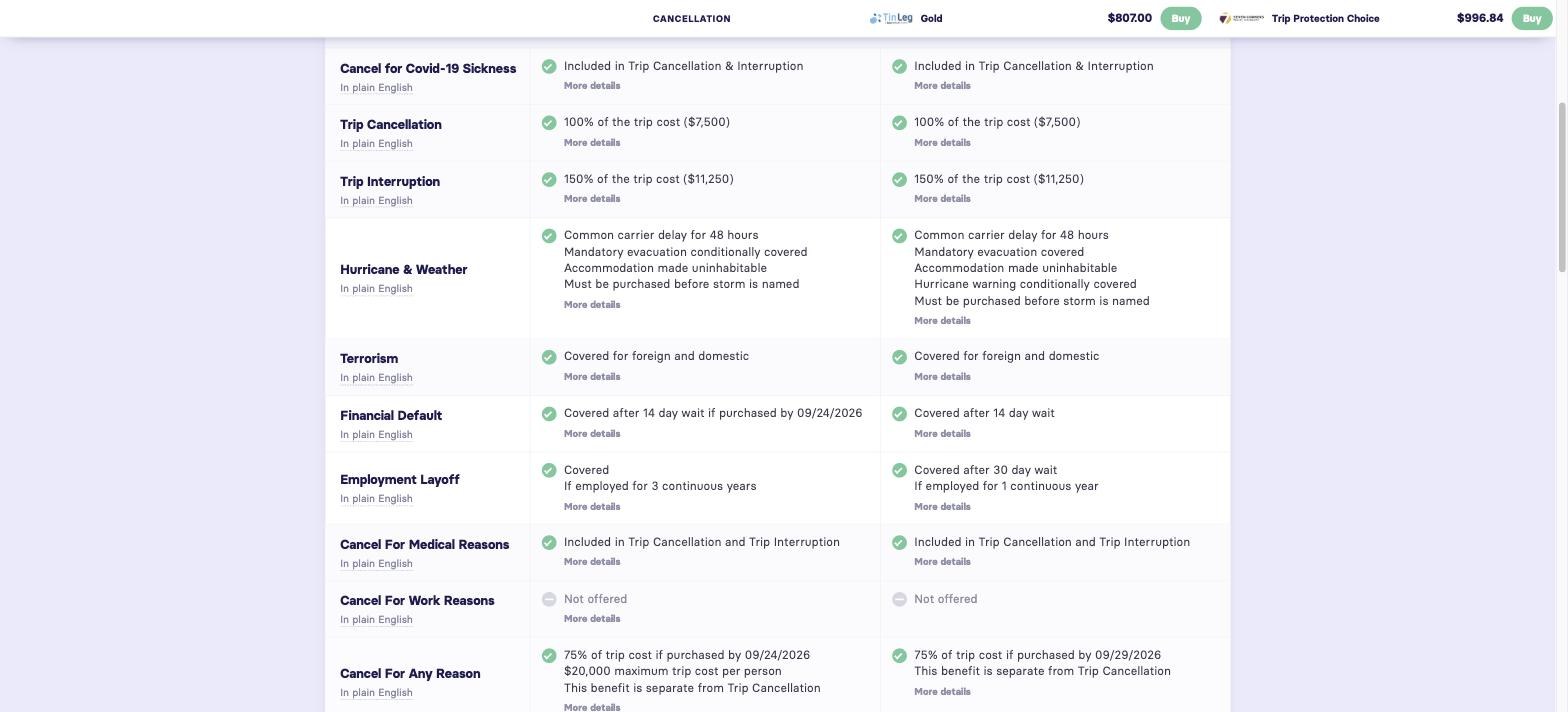
Buy Now takes you to the insurer’s checkout for that plan. You get the policy and certificate by email, and every plan has a free-look period of 10 to 15 days (21 on Travelex Ultimate) to cancel for a full refund if you have not left or filed a claim.
Same price as buying direct
Travel insurance is priced by the trip cost, the ages of the travelers and the trip length, and the rates are filed with state regulators, so the same plan costs the same wherever it is sold. The price on the comparison is the price on the insurer’s own site, so comparing costs nothing and leaves you with the plan document in hand. A package plan usually costs 4 to 8 percent of the trip cost; in the sample trip the top plans priced from $538 to $702 for two travelers on $7,500, which is 7 to 9 percent, because both travelers are over 65.
We check this every month. Our Travel Insurance Price Index prices five benchmark trips across every plan on the comparison. In September 2026 the five trips came in between 4.2 and 10 percent of the trip cost, and the cheapest plan for each trip was usually the one with no medical cover. If you are wondering whether buying direct is cheaper, the short answer is no, and here is why.
Mistakes people make when comparing
Comparing on price first. Sort the list by what it pays, then take the cheapest plan that carries the limits you need. A $150 plan with $10,000 of medical and a $250 plan with $250,000 of medical are not the same product at different prices.
Reading the plan name instead of the limit. Names such as Luxury, Preferred and Elite do not track the limits. Tin Leg Luxury carries $100,000 of medical and is the floor for a trip abroad, not the top; Travel Guard Preferred carries $50,000.
Getting the first deposit date wrong. The waiver and cancel-for-any-reason windows count from the first payment on anything, including a refundable airfare or a cruise deposit. Enter the real date; the comparison then shows you what you can still add.
Insuring the wrong amount. Insure the prepaid, nonrefundable total. Leaving out a booking to save on premium can void the waiver, which requires you to insure the full trip cost.
Skipping the certificate. The card is a summary. The certificate is the contract, and it is one click away in Policy Details.
Questions people also ask
What is the best way to compare travel insurance?
Enter the trip once on a comparison that prices every plan from the insurers’ own rates, then filter by the benefits you need (medical and evacuation limits first) and take the cheapest plan that carries them. Read the certificate before you buy. The price is the same as buying direct, so the comparison is the shortcut, not a markup.
How many travel insurance companies can I compare on CoverTrip?
More than 20 companies. The sample trip on this page returned 49 plans. The 12 companies CoverTrip reviews in depth are in the table above; nine are priced on the comparison and three sell direct only.
Is it cheaper to buy travel insurance direct from the insurer?
No. Travel insurance rates are filed with state regulators and the same plan costs the same everywhere it is sold. Comparing shows you the price you would pay direct, next to every other plan.
What is the difference between comparing plans and comparing companies?
A company sells several plans with different limits, so compare plans. Seven Corners Trip Protection Basic carries $100,000 of secondary medical and Choice carries $500,000 of primary medical; the company name tells you nothing about which one you are buying.
How long do I have to buy travel insurance?
There is no deadline: you can buy a plan up to the day you leave. The pre-existing condition waiver and cancel for any reason are the two things with a clock, usually 14 to 21 days from your first trip payment (24 hours on Generali). Buy inside that window if you want either one.
Can I compare travel insurance for a cruise?
Yes. Enter the cruise the same way, using the day you leave home and the day you get back, then tick Cruise in the trip-specific filters and Medical Evacuation in the evacuation filters. The cruise guide explains why the evacuation limit matters most at sea.
Related: all company reviews · what travel insurance covers · how much travel insurance costs · cancel for any reason guide · cruise travel insurance guide · pre-existing conditions
Plan limits on this page are from the insurers’ plan documents for the 12 reviewed companies, checked 12 September 2026, and from the CoverTrip reviews of each company. Screenshots and prices are from the CoverTrip comparison on 13 September 2026 for the sample trip described above; your prices will differ with your trip cost, ages and dates.
Compare every top plan priced for your trip
Enter your trip once and every top plan comes back side by side, priced for your dates. Same price as buying direct.
See plans & pricesAbout 60 seconds. Nothing to sign up for.Related

Damian TysdalDamian Tysdal is the founder of CoverTrip and a licensed travel insurance agent since 2006. He believes travel insurance should be easier to understand, and started the first travel insurance blog in 2006. About CoverTrip.